

Last Updated: November 17, 2026
Quick Summary
A mandala intention setting class for beginners asks for no prior skill, only attention: you bring paper, a pencil, and one clear sentence about the coming season. You then draw a circle and fill it in ring by ring, letting each repeated shape match one breath. This simple sequence quiets the noise long enough for a real mandala intention to surface, even if you insist you cannot draw.
- Choose your intention in present tense, keep it positive, and make it short enough to remember without a note.
- Write your intention lightly at the top of the paper before you draw the center point.
- Mark the center, draw the boundary circle, divide it, then build outward ring by ring.
- Match one full breath to one repeated shape as you draw each ring.
- A 45-minute home lesson runs from settling in and writing your intention to coloring and reflecting.
Table of Contents
- Why a Mandala Intention Class Suits Complete Beginners
- Intention Setting Examples for Mindfulness You Can Copy
- Mandala Drawing Materials for Beginners: What to Buy and What to Skip
- Mandala Drawing for Beginners Step by Step
- Mandala Meditation for Beginners: Where Breath Fits In
- In-Person or Online: Choosing a Beginner-Friendly Class
- Troubleshooting the Snags That Stop Most First-Timers
- Book a Guided Intention Mandala Class
- Frequently Asked Questions
Why a Mandala Intention Class Suits Complete Beginners
A mandala intention setting class for beginners works because it asks for no prior skill, only attention. You sit down with paper, a pencil, and one clear sentence about what you want the coming season to hold.
The structure is what makes it beginner-friendly. There is no wrong answer on the page, no perspective to master, no shading technique to fail at. A circle is a circle.
What the Circle Actually Represents
The circle is the whole practice. A mandala is a circular design built outward from a center point, used across many traditions as a tool for focus, reflection, and self-expression. In Sanskrit the word loosely means circle or center, and that single geometric rule, that everything radiates from and returns to a middle, is what separates a mandala from any other doodle.
Some artists experience that constraint as a limit. Others find it freeing, precisely because the shape decides the hard part for you. You only have to decide what goes in each ring.
Intention Setting Examples for Mindfulness You Can Copy
An intention is not a goal with a deadline. It is a direction you choose to move in, phrased so you can act on it today. The difference matters, because a goal ("lose ten pounds") invites judgment, while an intention ("I choose rest before I choose output") invites a decision you can actually make at 3 p.m. on a Tuesday.
Here are intention setting examples for mindfulness you can borrow, adapt, or reject outright:
- "I make room for quiet before I answer."
- "I finish what I start, even when it is small."
- "I let one thing be enough today."
A Four-Step Method for Choosing Your Intention
Most beginners arrive at a mandala class with a vague wish ("I want to be less stressed") and no idea how to turn it into something they can draw. Use this sequence before you pick up a pencil.
- Name the season you are in. Write one honest sentence about what is actually happening in your life right now, without judging it. "I am finishing a long project and I am tired" is enough.
- Identify the direction, not the outcome. Ask: what quality do I want to bring to this season? Rest, courage, patience, curiosity, boundaries, or play are common answers. Choose one word.
- Draft the sentence in present tense. Turn the word into a phrase you can act on today. "I choose rest before output" works because it describes a decision, not a result.
- Test it against three questions. Is it present tense? Is it positive (describing what you move toward)? Is it short enough to remember without checking a note? If any answer is no, revise and test again.
A useful intention passes all three tests. Watch out: the most common mistake is writing a to-do list and calling it an intention. "Meal prep on Sundays, call my sister, go to the gym" is a schedule, not a direction. If your sentence has three clauses and a comma, cut it until one clear phrase remains.
Prompts to Uncover an Intention When You Feel Stuck
If the four-step method feels abstract, answer one of these prompts in a single sentence and use that sentence as your starting point:
- What do I want more of in the next three months?
- What do I want to protect my energy from?
- What would I like to be true about how I spend my mornings?
Keep the answer private. The intention is for you, not for an audience, and it does not need to sound impressive. A plain sentence you believe is more useful than a poetic one you borrowed.
How to Carry the Intention Into the Drawing
Once you have your sentence, write it lightly at the top of your paper before you draw the center point. Then choose one visual element to represent it: a color, a repeated shape, or a symbol you associate with the quality. If your intention is rest, you might repeat a soft, rounded petal shape in cool colors. If it is courage, you might use a sharper triangle and warmer tones.
Mandala Drawing Materials for Beginners: What to Buy and What to Skip
You need very little to start: square paper, a pencil, an eraser, a ruler, and a compass. That is the entire honest list. Everything beyond it is preference, not requirement.
Buy these:
- White square paper, because the square frame makes centering easy
- A compass, for a true center and even rings
- A ruler, for dividing the circle into equal sections
Skip these at first:
- Full acrylic paint sets, which add drying time and cleanup to a practice meant to be calm
- Professional dotting tools, which reward experience you do not have yet
- Expensive specialty paper, which makes beginners hesitate to make a mark
If you would rather not source each item separately, our Virtual Mandala Class Kit bundles the paper, pencils, markers, stencils, compass, ruler, and printed instructions together, along with Kathy Rausch's Activate Divine Creativity book and workbook.
Mandala Drawing for Beginners Step by Step
Here is the sequence we teach, and it is deliberately simple. Mark the center, draw the outer boundary, divide the circle, then build outward ring by ring. Each ring repeats a shape you already drew, which is why the design looks intricate when it is finished and easy while you are making it.
- Find the center. Mark the middle of your square paper with a light pencil dot.
- Draw the boundary circle. Set your compass and draw one clean outer circle.
- Divide the circle. Use your ruler to draw light lines through the center, creating equal pie sections.
- Draw your first ring. Pick one simple shape and repeat it in every section, close to the center.
- Build outward. Add a new ring, changing one thing: the shape, the size, or the spacing.
- Color last. Fill in with colored pencil once the pencil structure is done.
A 45-Minute Lesson Plan You Can Run at Home
Set a timer and let the structure carry you. Minutes 0-5: settle in, breathe, and write your intention at the top of the page. Minutes 5-10: draw the center and boundary circle. Minutes 10-30: build three to four rings, one at a time.
Expected result: a completed mandala, however wobbly, and a clearer sense of what your intention actually means to you.
Mandala Meditation for Beginners: Where Breath Fits In
Breath is the thread that turns drawing into meditation. Before your pencil touches paper, take three slow breaths and let your shoulders drop. Then, as you draw each ring, let one full breath match one repeated shape.
That rhythm is the whole technique. Mandala meditation for beginners does not require a cushion, a mantra, or a silent room. It requires your hand moving at the speed of your breath, which naturally slows both.
In-Person or Online: Choosing a Beginner-Friendly Class
Both formats work. The right choice comes down to how you learn best and how much structure you want around you. In person, a teacher can see your page and correct a wobbly compass circle before it frustrates you. Online, you can pause, rewind, and practice in your own space with no audience.
Use these criteria when you compare beginner classes:
- Teacher experience: does the instructor actually draw and teach mandalas, or is this a general craft session?
- Beginner framing: is the class explicitly built for people with no art background?
- Materials clarity: is there a clear supply list, or a kit provided?
If you want live guidance from anywhere, our Live Virtual Mandala Doodles drawing class runs over Zoom with artist Kathy Rausch, includes a step-by-step PDF and a class recording, and requires no art experience. If you would rather sit in a room with other beginners, the in-person mandala class at Java Central in Westerville gives you a guided afternoon with materials and instruction in one place.
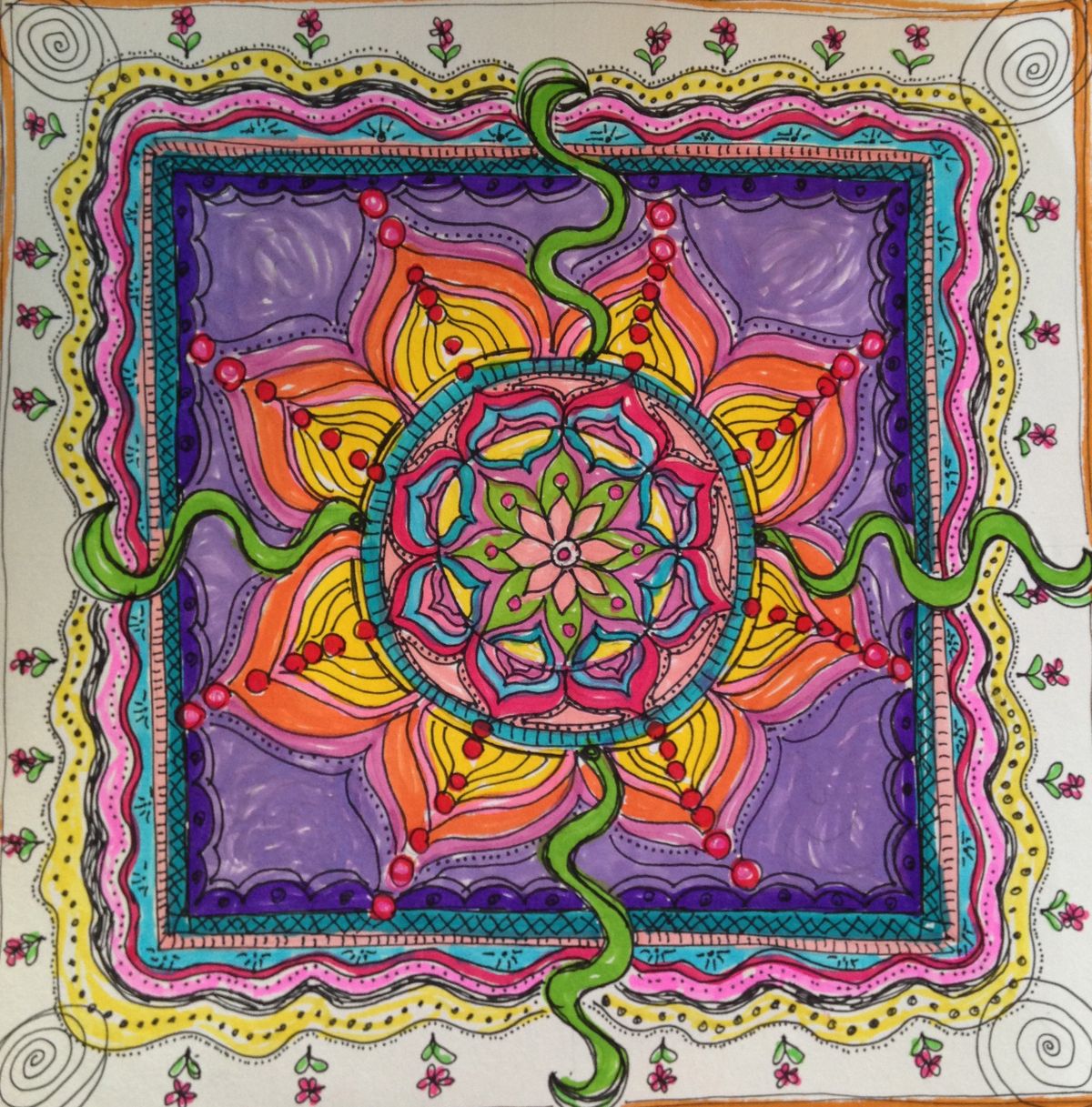
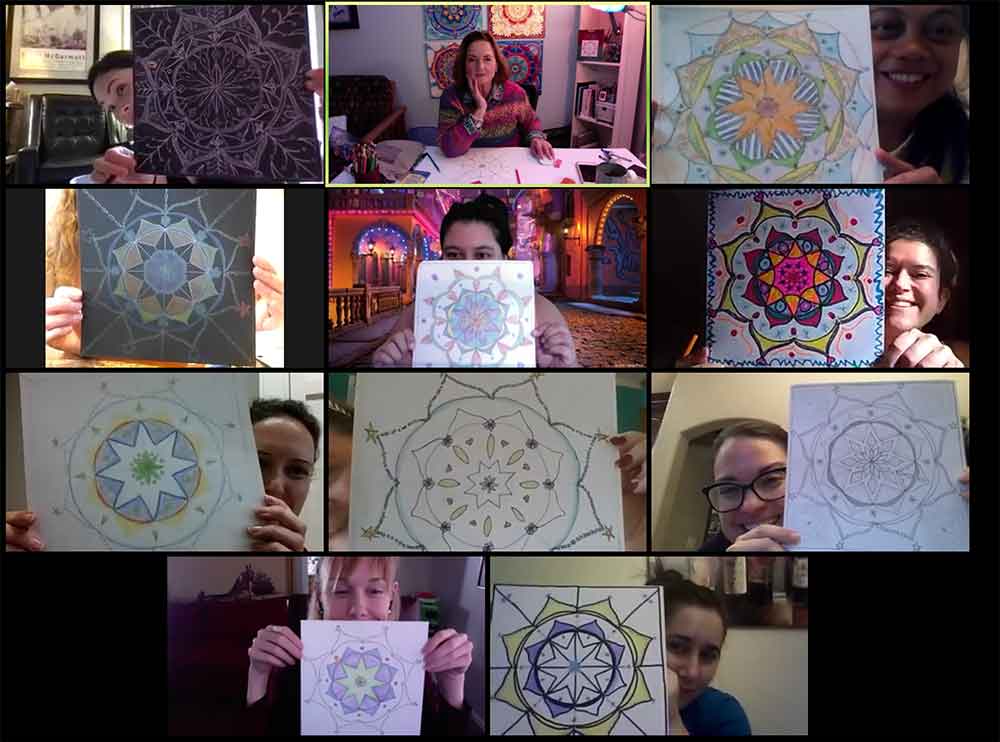
| Class format | Best for | What you leave with |
|---|---|---|
| Live virtual class | Remote learners who want feedback | Finished mandala, PDF guide, recording |
| In-person local class | Beginners who want hands-on help | Completed mandala, clear intentions, a touchstone |
| Self-guided kit | Independent practice at home | Supplies, book, printed instructions |
Troubleshooting the Snags That Stop Most First-Timers
Most beginners quit at the same three points, and all three are fixable. The circle comes out lopsided, the pattern gets repetitive and boring, or the blank page feels paralyzing before you start. None of these mean you are bad at this.
- A wobbly circle: draw lighter, rotate the paper instead of your wrist, and accept a little irregularity. Hand-drawn circles are supposed to breathe.
- Pattern fatigue: change exactly one variable per ring, not all of them. New shape, same spacing. Same shape, new size.
- Blank-page freeze: start with the smallest ring near the center. Small marks are less intimidating than a full design.
If you are worried about protecting a finished piece, our guide to caring for mandala printed cotton walks through washing and handling step by step.
Book a Guided Intention Mandala Class
The fastest way to learn this practice is to sit with someone who has taught it for years. Our Mandala Intentions Class is built for exactly the reader this article describes: no drawing experience, one clear intention, and a finished mandala to carry home as a daily touchstone.
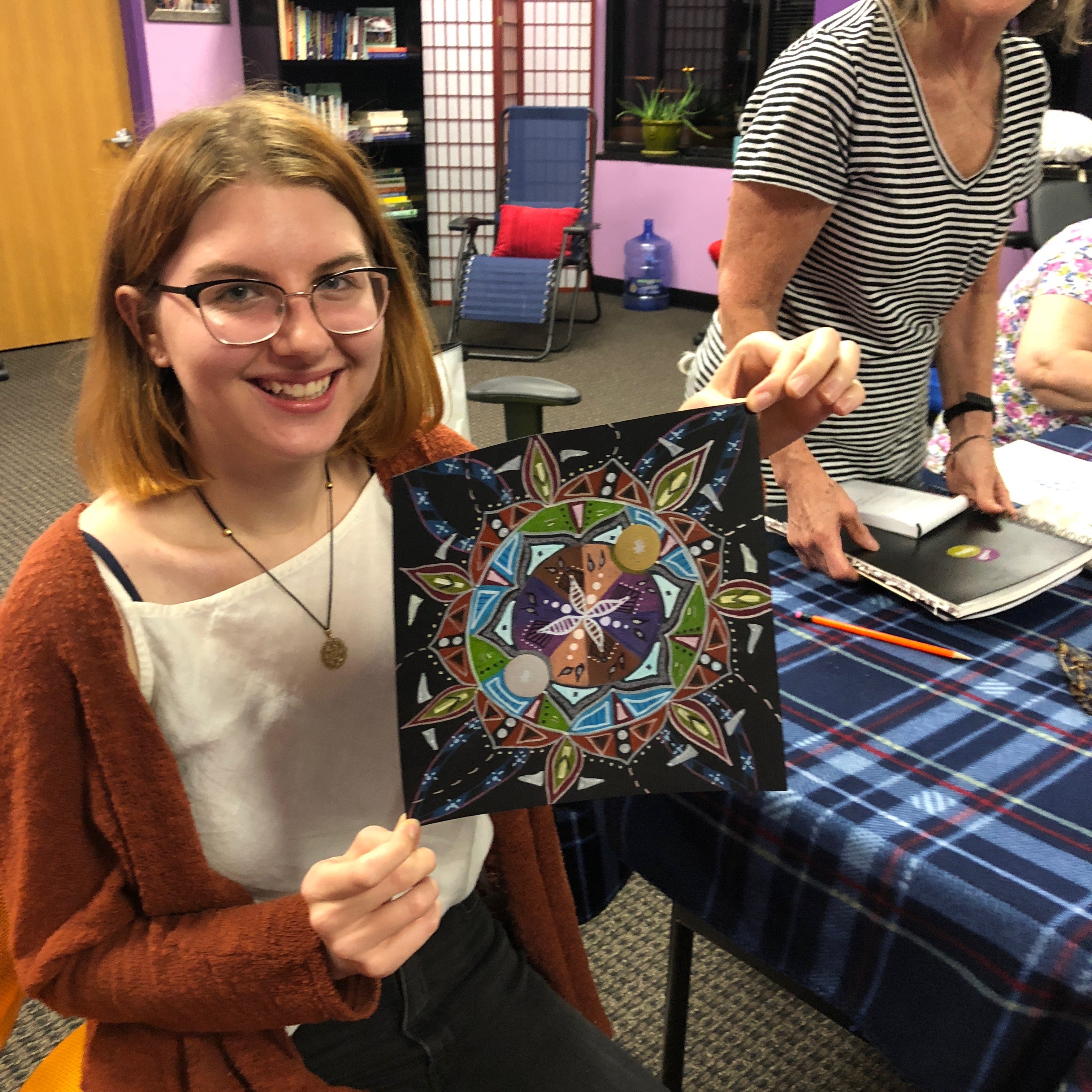
You will leave with a completed mandala that is uniquely yours, practical ways to use it as a reminder through the year, and a renewed sense of calm and possibility.
You do not need talent to begin this practice. You need forty-five minutes, a pencil, and one honest sentence about what you want more of in your life. That is the whole barrier, and it is lower than most people expect.
Frequently Asked Questions
How do you set an intention before creating a mandala?
Sit with your paper for a minute before you draw. Ask yourself what you want more of in the coming months, then write it as a short present-tense phrase such as 'I make room for rest' or 'I speak up in meetings.' Keep it to one sentence. Say it once, then start your circle. The point is to give the drawing a direction, so your mandala intention becomes a visual anchor rather than a decoration. Kathy Rausch's guided class builds this pause in before any pencil touches paper.
Do you need to know how to draw to make a mandala?
No. A mandala is built from a circle, a center point and repeated marks, so the structure does the work. If you can hold a ruler and a pencil, you can lay out the grid. Start with a compass for the outer circle, divide it into even sections, then repeat one simple shape in each section. The I Love Mandalas Mandala Drawing Kit includes stencils, a compass and a ruler.
What materials do beginners need to create an intention mandala?
You need square paper, a pencil, a pencil sharpener, a ruler, a compass and something to color with. The Mandala Drawing Kit bundles supplies including colored pencils, markers, stencils, a compass, a ruler and printed instructions. If you are testing the practice first, a plain sketchbook and one pen are enough to start.
How long should a beginner spend drawing an intention mandala?
Set aside 45 minutes for a first session: about 5 minutes to settle and phrase your intention, 10 minutes to lay out the circle and grid, 25 minutes to draw and color, and 5 minutes to reflect on what came up. Shorter 20-minute sessions work well once you know the process. Longer than an hour on a first attempt tends to produce frustration rather than focus, so stop while you still feel calm.
