

Table of Contents
- Why Mandala Art Works for Stress Relief
- How to Draw a Mandala for Beginners
- Mandala Coloring for Mindfulness
- Mindful Drawing Exercises You Can Do Today
- Mandala Drawing for Stress Relief as a Daily Practice
- Adapting Mandalas for Different Needs and Abilities
- What the Research Actually Shows (and What It Doesn't)
- Frequently Asked Questions
Last Updated: October 16, 2026
Why Mandala Art Works for Stress Relief
Learning how to use mandala art for stress relief combines visual creativity with meditative focus, creating a calming effect on mind and body. At I Love Mandalas, we offer resources to help people discover how mandala drawing and coloring can transform their relationship with stress.

The calming effect of repetitive patterns
Repetitive patterns settle the mind. Drawing or coloring the same shapes over and over puts your brain into a rhythm that slows racing thoughts.
Repetition gives your mind a single focus point: instead of jumping between worries, your attention stays on the pattern in front of you, much like counting breaths in meditation.
Many people find anxiety drops noticeably after just 10 minutes. Hands busy and mind occupied, this focused activity can help reduce feelings of stress.
How symmetry and radial balance anchor attention
Mandala art relies on symmetry and radial balance, geometric properties that naturally hold your attention. Symmetry feels ordered and safe to the brain.
Creating a mandala from the center outward builds balance with every line, each side mirroring the other, a visual anchor against stressful thoughts.
Radial balance means the design radiates from a central point, like spokes on a wheel, mirroring natural forms such as flowers, snowflakes and atoms.
How to Draw a Mandala for Beginners
Drawing a mandala from scratch is simpler than it looks. You don't need artistic talent, just basic tools, patience, and a willingness to start at the center and work outward.
What you'll need: materials and setup
Start with these essentials:
- White or black paper (square or round)
- Pencils (regular and colored)
- A compass or circle template
- A ruler
- Fine-tip black markers or pens
- Colored pencils or markers (optional for later)
Set up in a quiet place with good lighting and no distractions for the next 15 to 30 minutes.
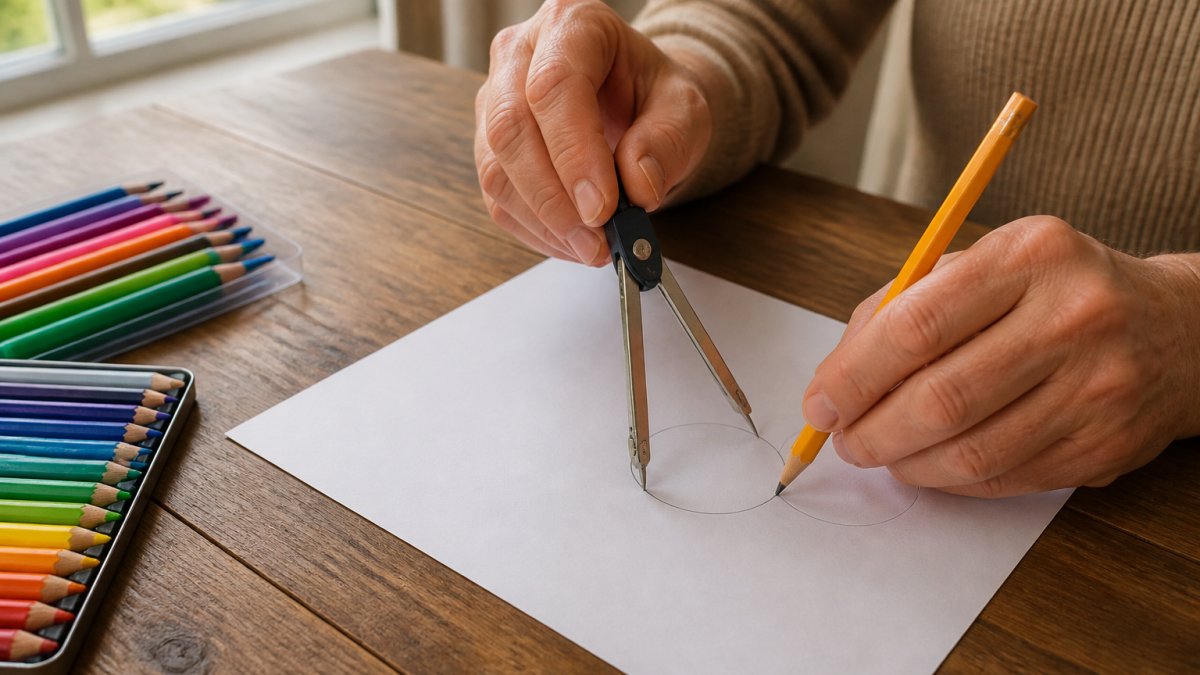
Drawing from center outward
Start with a single point at the center of your paper and use your compass to draw a small circle around it, this is your anchor.
Within each ring, add simple shapes:
- Dots
- Lines
- Petals
- Triangles
- Small squares
Keep shapes simple at first; complexity comes naturally as you repeat. The key is consistency, if you put a dot in one section, mirror it in the next. Work slowly.
A structured 10-minute beginner session (step-by-step)
"Just start drawing" stalls beginners.
Before you start (30 seconds): Rate your stress on a scale of 1 to 10.
Minutes 1-3, Build the rings. Draw two more circles around the center, each slightly larger than the last.
Minutes 7-10, Add a border and finish. Draw one final circle around the outermost ring.
After (30 seconds): Rate your stress again on the same 1-to-10 scale.
Adapting the session to your needs
This ten-minute structure is a starting point, not a rule. Common adaptations:
- Limited dexterity or hand pain: Skip the compass and use a pre-printed mandala template. Color instead of draw. The timed structure still works.
- Low vision: Use a bold black marker on white paper, or work on a larger sheet so the shapes are easier to see.
- Low confidence or "I can't draw" anxiety: Start with a coloring page rather than a blank sheet. You still get the repetitive-motion and color-choice benefits.
- Very little time: Compress to five minutes, one center circle, one ring of dots, one border. The mechanism (repetition plus focus) does not require a long session.
- Digital option: Free mandala apps and tablet drawing apps let you undo mistakes instantly, removing the perfectionism barrier for some. The trade-off: screen use can feel less grounding than paper, try both and notice which settles you faster.
Mandala Coloring for Mindfulness
Once your outline is complete, coloring brings it to life. It's often easier than drawing for beginners and equally calming.
Selecting colors intuitively
Don't overthink color choices. Intuitive selection means picking colors as you feel drawn to them, not by a plan: start with one that appeals to you, fill a section, then choose the next based on what feels right. Some people use warm colors (reds, oranges, yellows) for energy and cool colors (blues, purples, greens) for calm, but there's no rule.
Mindful Drawing Exercises You Can Do Today
You don't need hours to benefit from mandala art. Even short sessions can create a sense of calm.
A 15-minute timed mandala session for acute stress
Use this exercise when stress hits hard and you need relief fast.
Set a timer for 15 minutes. Gather your materials.
Minutes 1-2: Draw your center circle and first two rings. Don't overthink.
Minutes 3-10: Fill the rings with repetitive shapes. Dots, lines, petals, whatever comes.
Minutes 11-15: Add details or start coloring if time allows.
When the timer ends, pause and notice how you feel.
Troubleshooting perfectionism and frustration
Perfectionism kills the calming effect. Focused on making your mandala "perfect," you're not meditating, you're performing.
If a line isn't straight: It doesn't matter, mandalas are forgiving and asymmetry adds character.
If you make a mistake: Embrace it.
If you get frustrated: Stop, breathe, step away for five minutes. The mandala will be there when you return.
Remember: the goal is calm, not perfection.
Mandala Drawing for Stress Relief as a Daily Practice
The real power of how to use mandala art for stress relief emerges when you make it a habit. A daily 10 to 15-minute practice creates lasting shifts in how you handle stress.
Building a sustainable routine
Pick a specific time each day, morning sets a calm tone before stress arrives, while others prefer evening as a wind-down ritual. Keep supplies in one place so you never hunt for materials. Start with 10 minutes; consistency matters more than duration, and a daily 10-minute practice beats a once-a-week hour-long session.
Tracking your personal response
Notice what happens in body and mind after each session: Do you feel calmer, more focused, more creative? Does your sleep improve?
Keep a simple log:
| Date | Time Spent | Stress Level Before | Stress Level After | Notes |
|---|---|---|---|---|
| Oct 16 | 15 min | 7/10 | 4/10 | Felt focused, hands relaxed |
| Oct 17 | 12 min | 6/10 | 3/10 | Easier than yesterday |
| Oct 18 | 20 min | 8/10 | 5/10 | Took longer to settle |
Tracking reveals patterns, which times of day work best and how consistent practice builds resilience. Over weeks, consistent practice can help individuals manage stress more effectively.
The Live, Virtual Mandala Doodles Drawing Class from I Love Mandalas offers guided sessions with artist Kathy Rausch.

Adapting Mandalas for Different Needs and Abilities
Mandala art is flexible enough for different ages, abilities and stress levels.
For children: Simpler designs with larger sections. Pre-drawn outlines to color.
For people with limited mobility: Coloring mandalas requires less precision than drawing. Larger designs reduce eye strain.
For high anxiety: Start with coloring rather than drawing. The structure is already there.
For groups: Mandala drawing becomes a shared meditation. Families can draw together.
The Mandala Class at Java Central in Westerville offers in-person guided sessions where you create an Intentions Mandala.

What the Research Actually Shows (and What It Doesn't)
Mandala art has gained attention for stress relief, but it's worth separating what the evidence supports from what remains unclear so you can approach the practice with realistic expectations.
What the evidence supports
The strongest, most consistent finding across studies of art-making and stress is simple: repetitive, focused creative activity tends to reduce self-reported anxiety and improve mood in the short term (pubmed.ncbi.nlm.nih.gov).
Research commonly suggests structured coloring, including mandala coloring, can produce a state similar to mindfulness meditation: attention narrows to the present task, breathing slows and rumination decreases.
What the evidence does not support
Several common claims go beyond what the research can currently show:
- It is not a treatment for clinical anxiety, depression, or PTSD. Art-based practices are sometimes used as complementary tools within therapy, but they are not a substitute for professional care. If stress or anxiety is interfering with sleep, work, or relationships, talk to a doctor or licensed therapist.
- Long-term effects are not well established. Most studies measure how people feel immediately after a session or over a few weeks (pubmed.ncbi.nlm.nih.gov). Whether a daily mandala habit changes your baseline stress level over months is plausible but not firmly proven.
- Individual responses vary widely. Some feel a clear shift after one session; others notice nothing at first and only feel a difference after a week of consistent practice. A smaller group finds drawing increases frustration rather than reducing it, usually because perfectionism takes over. That's a signal to switch to coloring or a template, not a sign the practice "doesn't work" for you.
- "Mandala" is not a magic ingredient. The evidence points to repetition, focus, and structure as the active elements, not the specific circular format. A repeating doodle or a zentangle-style pattern likely produces similar effects. Mandalas are simply a convenient, aesthetically pleasing container for the mechanism.
How to use this information
Treat mandala art as one tool in a broader stress-management toolkit, not a standalone cure, it pairs well with sleep, movement, social connection and, when needed, professional support. The most honest way to evaluate it is to track your own response over two to three weeks with a simple before-and-after stress rating. If your numbers trend downward and you look forward to sessions, it's working.
Frequently Asked Questions
Does mandala art actually reduce stress, or is it just a pretty distraction?
Mandala art engages your focus through repetitive patterns and symmetry, which naturally shifts attention away from stress triggers. The act of creating or coloring a mandala activates the same calming response as meditation. However, it works best as a consistent practice rather than a one-time fix. Research suggests benefits include reduced anxiety levels and improved emotional well-being, though results vary by person. The key is using it regularly, even 15 minutes daily, to build the habit.
How long should you spend drawing or coloring a mandala for stress relief?
Start with 15 to 20 minutes for a beginner mandala drawing or coloring session. This timeframe is long enough to enter a focused, meditative state but short enough to fit into a busy schedule. Some people find 30 minutes ideal for deeper relaxation. The Mandala Drawing Kit includes supplies and instructions for sessions you can complete in one sitting. The important factor is consistency, regular practice matters more than duration.
Do you need to be good at drawing to make a mandala for stress relief?
No artistic skill is required. Mandalas are built on simple geometric principles: circles, symmetry, and repetition. Even if your lines aren't perfect, the stress-relief benefit comes from the process of creating, not the final result. Beginners often use compasses, rulers, and stencils to guide their designs. The Live Virtual Mandala Drawing Class and Mandala Drawing Kit both emphasize that complete beginners create beautiful mandalas by following step-by-step instructions without prior experience.
Can you use mandala art during an acute stress moment, or is it only for regular practice?
Mandalas work for both immediate stress relief and long-term practice. When you're in an acute stress moment, a simple 15-minute mandala drawing or coloring session can interrupt the stress response and ground you in the present. Coloring pre-drawn mandalas is faster than drawing from scratch, making it ideal for urgent situations. For lasting benefits, integrate mandala art into your weekly routine. Over time, the practice builds psychological resilience and helps you manage stress more effectively.